Robotaxi Digest: Uber bets $10B against Waymo, China freezes AV permits, ECARX's geopolitical workaround
Five developments that shifted the global robotaxi investment landscape in the week of May 12–19: Uber's $10B pivot to AV asset ownership, Waymo's 1,400 sq mile expansion across 11 cities, China's nationwide AV permit freeze after Baidu's Wuhan outage, ECARX and May Mobility's $750M compliance-first supply deal, and tightening US regulations in California and DC.
The week of May 12–19 was unusually compressed for global AV commercialization. Three storylines — US platform economics, China's safety-triggered regulatory pause, and the Middle East as an emerging deployment theater — converged at the same time, all moving the investment calculus in different directions. This issue covers the five most consequential developments.
Uber goes from AV platform to AV asset owner — $10B later
The clearest signal of the week came from Uber. The company has now committed more than $10 billion to build its own autonomous vehicle fleet, spread across equity investments in Rivian ($1.25 billion, up to 50,000 R2 robotaxis), Lucid ($500 million for at least 35,000 Gravity SUVs), and Nuro, which just secured a California driverless permit to test Lucid vehicles without a safety driver 1.
The pivot is a direct response to Waymo's independent scaling. Waymo now delivers roughly 400,000 paid rides per week and is targeting 1 million by year-end. With its own app, its own customer base, and ongoing city expansions without Uber's help, Waymo has demonstrated that AV operators may not need platform intermediaries at all — a scenario Uber's original asset-light model assumed would never arrive.
So Uber pivoted to asset ownership. The first Lucid-Nuro robotaxis are planned for San Francisco — Waymo's home market — by late 2026. Rivian R2 robotaxis arrive in SF and Miami from 2028. Meanwhile, Uber executives have spent weeks publicly characterizing Waymo as "less scalable" and "less reliable," while Uber CTO Praveen Neppalli posted a video calling a Waymo encounter "scary." Waymo vehicles still operate on Uber's platform in Austin and Atlanta 1.
The dynamic is worth watching for investors in either company: Uber is now building a parallel fleet to hedge against the operator it still depends on, and those two bets will generate conflicting incentives for the next 18–24 months.
Waymo reaches 1,400 sq miles across 11 US cities
Waymo expanded its US service area to more than 1,400 square miles across 11 cities — a 27% jump from its April footprint, adding roughly 300 square miles 2. Miami is the latest market, where Waymo launched in January (60 sq miles), expanded to Miami Beach in April, and added more territory this week ahead of the World Cup. Austin, Atlanta, Houston, and the Bay Area are all next for broader coverage.
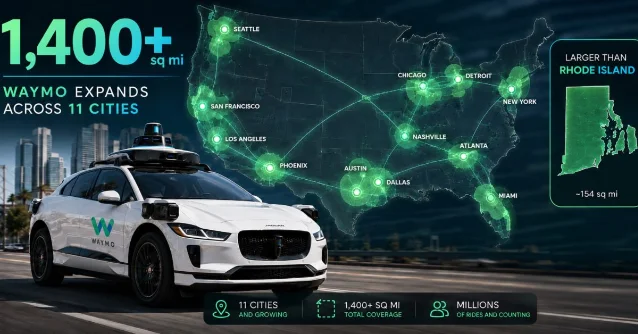
The fleet currently runs roughly 3,000 vehicles, all based on the sixth-generation Waymo Driver — built on the Zeekr RT platform with Waymo-designed sensors, manufactured in Mesa, Arizona. International expansion is now confirmed: London commercial launch is targeted for Q4 2026 after testing began in April; Tokyo is also in early deployment 2.
The growth pace matters for investors modeling TAM capture. Waymo went from 20 million cumulative rides at some point before 2026 to targeting 1 million rides per week by December. That's not a slow ramp.
China: Baidu's Wuhan outage triggers a permit freeze
In late April, more than 100 Apollo Go robotaxis stalled simultaneously across Wuhan — on main roads and elevated expressways — leaving passengers trapped for up to two hours. Emergency response systems failed: SOS buttons returned unavailable errors, customer service calls disconnected, and it took hours for Baidu staff and police to reach affected vehicles. At least three collisions with other road users followed 3.
Wuhan police attributed the incident to a "system failure." Baidu's initial customer service cited "network issues." The company has not publicly commented on the root cause.
The regulatory response was swift. Chinese authorities — led by the Ministry of Industry and Information Technology and two other ministries — suspended the issuance of new AV permits nationwide. The ban bars operators from adding vehicles to existing fleets, starting new test programs, or entering new cities. No timeline for lifting the freeze has been given. Apollo Go's Wuhan operations remain suspended 3 4.
The stock market read it quickly: Baidu fell 2.8% in Hong Kong on the Bloomberg report; Pony.ai dropped 5.5% and WeRide lost 4.7%. Both companies confirmed their existing fleets are operating normally and publicly supported the regulatory review.
This matters beyond China. Baidu alone runs more than 1,000 fully driverless vehicles in Wuhan, has 20 million cumulative orders nationally, and has international operations in Abu Dhabi, Dubai, and Switzerland. The Chinese AV sector was the most aggressive L4 deployment globally — that momentum is now on pause while the permit freeze holds.
ECARX and May Mobility: a $750M deal that routes around geopolitics
On May 19, ECARX — the automotive tech company backed by Geely founder Li Shufu — signed a framework agreement with US robotaxi operator May Mobility to supply thousands of purpose-built Level 4 vehicles, valued at approximately $750 million 5.
The deal's most significant structural element is where the vehicles will be built: outside China. That decision directly addresses the Commerce Department's ICTS rules and the Connected Vehicle Security Act of 2026, which restrict Chinese-origin hardware in connected vehicles on US roads. ECARX is, in effect, making Chinese automotive computing expertise accessible to an American customer while routing physical production through compliant jurisdictions 5.
The technology side is also notable. Rather than retrofitting consumer vehicles with aftermarket autonomy stacks, ECARX will deliver factory-integrated Level 4 computing platforms and sensor suites. Scale-up is targeted for 2028, with a stated goal of 50% reduction in per-vehicle autonomy hardware cost compared to current benchmarks.
May Mobility has completed more than 500,000 commercial autonomous rides in the US and Japan across partnerships with Toyota, Uber, Lyft, and Grab. The ECARX deal gives it a vehicle platform designed around its autonomy stack rather than adapted from a consumer model.
For investors tracking Chinese AV companies' Western strategies: this deal is the clearest example yet of the compliance-first structuring that Chinese-origin players will need to pursue in US and EU markets. The model is likely to be replicated.
Regulatory watch: US tightens on two fronts
Two separate US regulatory moves this week are worth flagging for their longer-term friction potential.
California, effective July 1: The DMV has adopted rules allowing police to issue traffic citations directly to AV manufacturers when a driverless vehicle commits a violation. Officers will deliver a "Notice of AV Noncompliance" to the company. The new rules also require operators to collect and report safety-related incident data and impose expanded testing requirements for permit applications. The rules apply to all operators in the state, including Waymo in San Francisco and Los Angeles 6.
Washington DC: On May 1, three DC Council members introduced the Autonomous Vehicle Deployment Authorization Amendment Act of 2026, which would establish a permit system with significant application fees and a vehicle miles traveled tax for AV operators in the district 7. The bill is still in committee, but DC was on Waymo's 2026 expansion list.
Neither of these individually stops deployment. Together, they signal that the free-run era for AV operators in major US markets is ending — compliance costs and operational liability are entering the unit economics.
The macro signal: $21.4B in AV funding through mid-April
One number from Crunchbase data rounds out the context: autonomous vehicle startups raised $21.4 billion across 34 deals through April 15, 2026 — up 262% compared to all of 2025 8. Uber's $10B commitment accounts for roughly half of that figure. Remove Uber and the underlying sector activity is still running at more than double last year's pace.
The investment surge is running parallel to tighter regulation and China's pause. That combination — capital flooding in as friction accumulates — is a setup worth monitoring. The companies that convert that capital into route-profitable operations before the next regulatory reset will be the ones that matter in 2027.
This digest covers the week ending May 19, 2026. Next issue: Tesla's driverless expansion outside Texas, Waymo's London commercial timeline, and whether China's permit freeze extends to existing fleet reductions.
参考来源
- 1Uber turns on Waymo as it pours $10B+ into owning robotaxi alternatives
- 2Waymo expands robotaxi coverage more than 20% — larger than Rhode Island
- 3China suspends new AV permits after Baidu's mass outage
- 4China suspends new autonomous vehicle permits after Baidu outage
- 5ECARX and May Mobility sign $750M robotaxi deal, vehicles built outside China for US compliance
- 6California to start ticketing driverless cars, including Waymo vehicles, in July
- 7D.C. Council proposes a costly path for autonomous vehicles in the nation's capital
- 8Autonomous Vehicle Startups Raise Record $21.4B in 34 Deals
围绕这条内容继续补充观点或上下文。